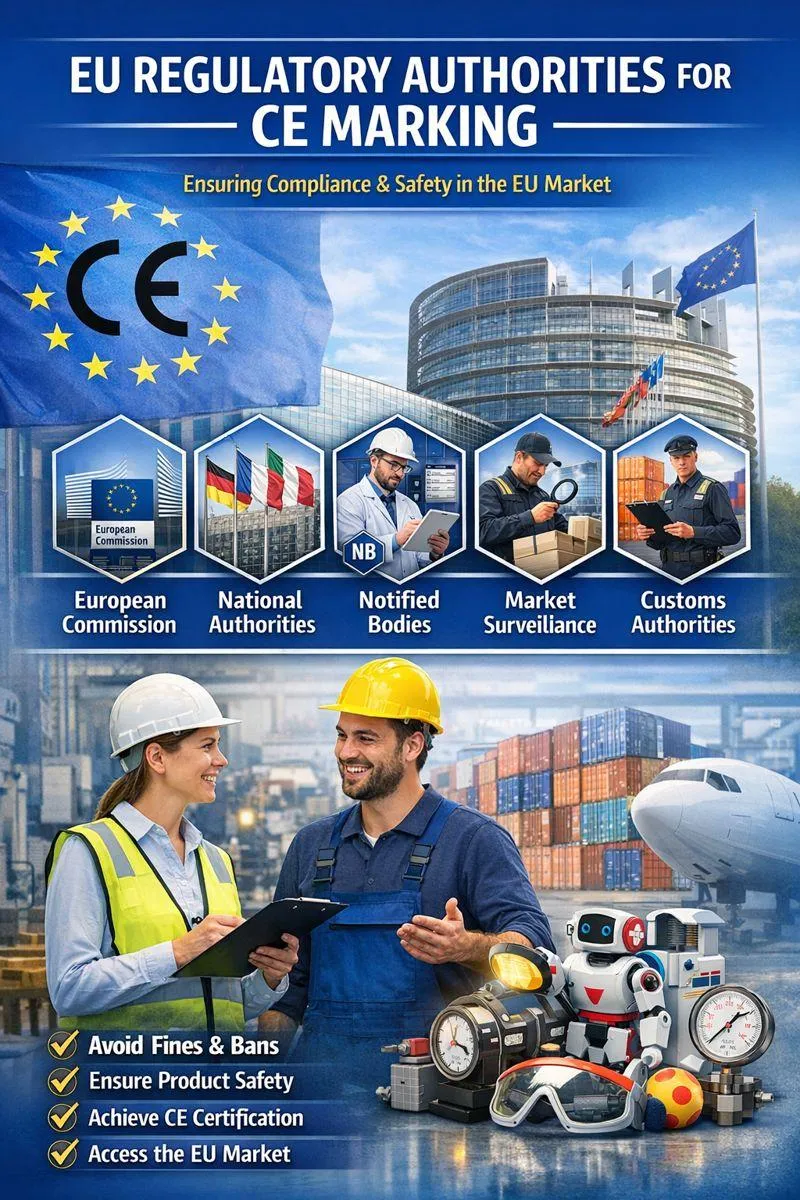
EU Regulatory Authorities for CE Marking
EU Regulatory Authorities for CE Marking
Introduction
CE Marking is a mandatory conformity marking for many products placed on the European Union (EU) market. It signifies that a product meets EU safety, health, and environmental protection requirements.
Behind CE Marking is a structured regulatory framework managed by EU Regulatory Authorities, ensuring that products sold in Europe are safe, compliant, and traceable.
This blog provides a detailed explanation of EU regulatory authorities, their roles, and how they work together in the CE Marking process.
What Is CE Marking?
CE Marking (Conformité Européenne) indicates that a product complies with applicable EU Directives and Regulations.
It is required for many product categories, including:
Machinery
Electrical & electronic equipment
Medical devices
Construction products
Personal protective equipment (PPE)
Toys
Pressure equipment
Without CE Marking, such products cannot legally be sold in the European Economic Area (EEA).
Key EU Regulatory Authorities for CE Marking
CE Marking is not controlled by a single authority. Instead, it operates under a multi-level regulatory system involving EU institutions, national authorities, and independent assessment bodies.
1. European Commission (EC)
Role & Responsibilities: The European Commission is the central authority responsible for:
Developing and enforcing EU Directives & Regulations
Publishing harmonized standards references
Overseeing the overall CE Marking framework
Coordinating market surveillance across EU states
Key Functions:
Issues New Legislative Framework (NLF) rules
Maintains the NANDO database (Notified Bodies list)
Ensures uniform application of CE requirements
📌 Important Note: The European Commission does not issue CE certificates. It sets the legal framework only.
2. National Competent Authorities (NCAs)
Each EU member state has its own National Competent Authorities responsible for enforcement.
Responsibilities:
Market surveillance
Product inspections & audits
Investigating non-compliant products
Taking legal action if products pose risks
Examples:
Germany: Federal Institute for Occupational Safety and Health (BAuA)
France: DGCCRF
Italy: Ministry of Economic Development
These authorities can:
Ban products
Recall products
Impose penalties
3. Notified Bodies (NBs)
What Are Notified Bodies?
Notified Bodies are independent organizations designated by EU member states and notified to the European Commission.
They play a critical role in CE Marking for high-risk products.
Key Responsibilities:
Conformity assessments
Product testing & certification
Factory audits
Technical documentation review
When Is a Notified Body Required? A Notified Body is mandatory for products such as:
Medical devices
Pressure equipment
PPE (Category II & III)
Construction products
Lifts & machinery (specific cases)
📌 Each Notified Body has a 4-digit identification number displayed next to the CE Mark.
4. Market Surveillance Authorities (MSAs)
Purpose:
Market Surveillance Authorities ensure only compliant products remain on the EU market.
Activities:
Random inspections, Customs checks on imported goods, Product testing, Consumer safety enforcement
If a product fails compliance: CE Mark can be invalidated, Sales can be stopped, Public warnings may be issued
5. Customs Authorities EU Customs work closely with MSAs to: Inspect imported goods, Stop non-compliant products at borders, Verify CE documentation
This is especially critical for non-EU manufacturers exporting to Europe. How These Authorities Work Together
Authority Main Function
European Commission Lawmaking & coordination
National Authorities Enforcement & penalties
Notified Bodies Testing & certification
Market Surveillance Product safety monitoring
Customs Authorities Border control
This system ensures high consumer protection and fair trade within the EU.
Why EU Regulatory Authorities Matter for Manufacturers
Understanding EU authorities helps manufacturers:
✔ Avoid legal penalties
✔ Reduce product recalls
✔ Ensure faster market access
✔ Build trust with EU customers
✔ Maintain long-term compliance
Non-compliance can result in:
Heavy fines
Product bans
Brand reputation damage
CE Marking Compliance: Manufacturer Responsibilities
Manufacturers must:
Identify applicable EU Directives
Conduct risk assessment
Prepare Technical Documentation
Perform conformity assessment
Issue EU Declaration of Conformity
Affix CE Mark correctly
EU authorities verify these steps during inspections.
Conclusion
EU Regulatory Authorities form a robust compliance ecosystem that ensures product safety, quality, and transparency.
For manufacturers and exporters, understanding this system is essential for successful CE Marking and uninterrupted access to the European market.
Working with qualified consultants and recognized Notified Bodies significantly reduces compliance risks and speeds up certification.