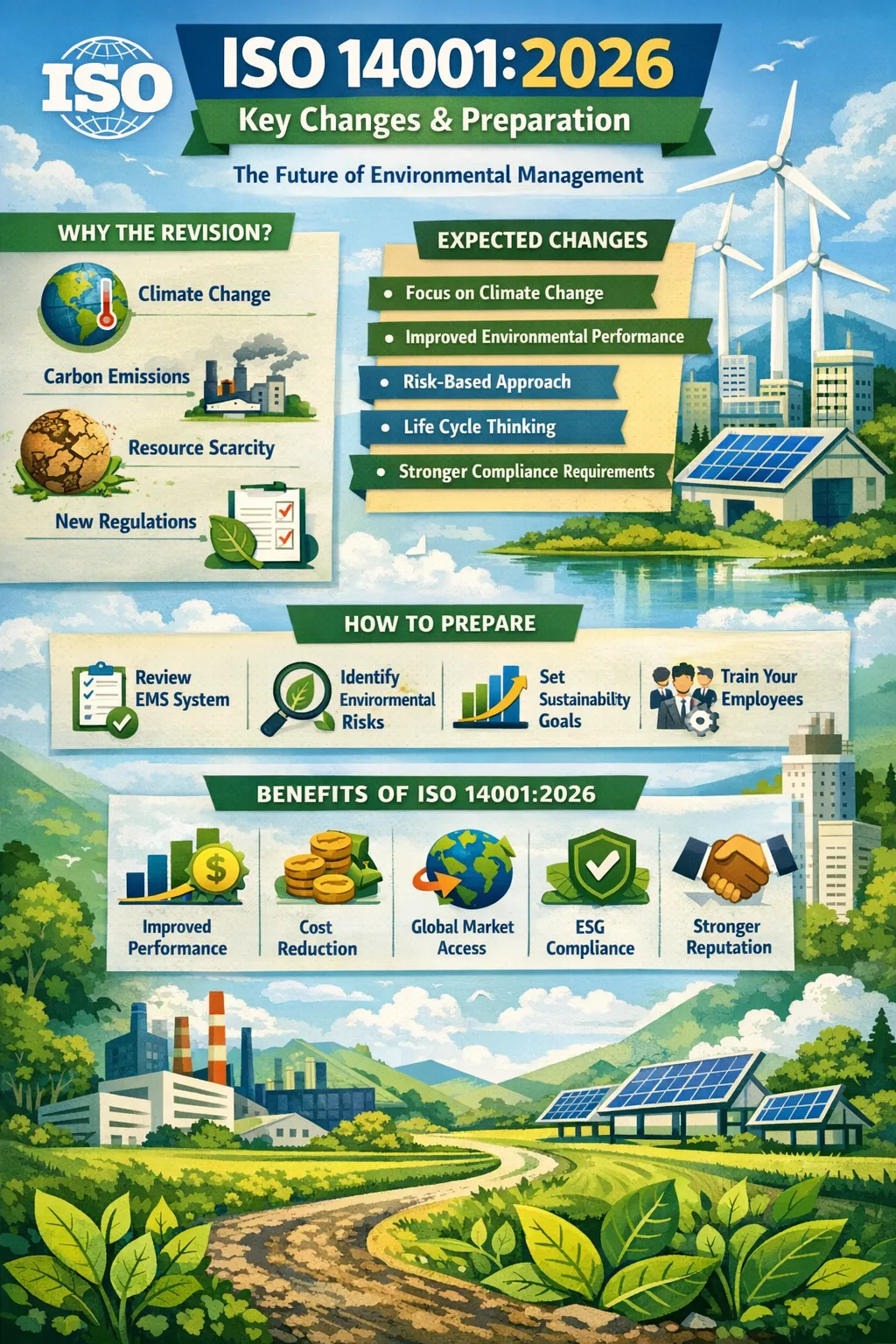
ISO 14001:2026 Key Changes and How Organizations Should Prepare
ISO 14001:2026 – Key Changes and How Organizations Should Prepare
Awareness Blog for Businesses & Environmental Professionals
Environmental sustainability is becoming a global business requirement rather than a voluntary initiative. With increasing climate risks, environmental regulations, and sustainability expectations from customers and international markets, organizations are under pressure to improve their environmental performance.
To address these global challenges, the International Organization for Standardization is working on the upcoming revision of ISO 14001:2026, which will replace the current ISO 14001:2015 standard.
This update is expected to introduce stronger environmental management requirements and align organizations with modern sustainability and climate change challenges.
What Is ISO 14001?
ISO 14001 is an internationally recognized standard for Environmental Management Systems (EMS). It provides a framework that helps organizations identify, manage, monitor, and improve their environmental impact.
The standard applies to all types of organizations, including:
Manufacturing industries
Construction companies
Food industries
Hospitals
IT companies
Logistics & supply chain companies
Educational institutes
Government organizations
ISO 14001 helps organizations reduce environmental risks, ensure legal compliance, and improve sustainability performance.
Why ISO 14001 Is Being Revised in 2026
The business environment has changed significantly since 2015. Major global issues such as:
Climate change
Carbon emissions
Resource scarcity
Environmental regulations
Sustainable supply chains
ESG (Environmental, Social, Governance) reporting have made it necessary to update the standard.
The ISO 14001:2026 revision will focus more on environmental performance improvement, not just management systems and documentation.
Expected Key Changes in ISO 14001:2026
While the final version is still under development, the following major changes are expected:
1. Strong Focus on Climate Change
Organizations will be required to identify how climate change affects their operations and how their activities impact the climate.
This means companies will need to consider:
Carbon emissions
Energy usage
Climate risks
Environmental sustainability goals
2. Improved Environmental Performance
Companies will need to show measurable environmental improvements, not just policies and procedures.
Examples:
Reduction in energy consumption
Reduction in waste
Reduction in water usage
Lower emissions
3. Risk-Based Environmental Management
The new revision will require organizations to identify environmental risks and opportunities and plan actions to address them.
This includes:
Pollution risks
Legal compliance risks
Supply chain environmental risks
Climate-related risks
4. Life Cycle Thinking
Organizations will need to consider the environmental impact of their product or service from raw material to disposal.
This includes:
Raw material sourcing
Manufacturing
Packaging
Transportation
Product usage
Disposal / recycling
5. Stronger Compliance Obligations
Organizations will need better systems to track and comply with environmental laws and regulations.
How Organizations Should Prepare for ISO 14001:2026
Organizations should start preparing now to ensure a smooth transition when the new version is officially published.
Preparation Steps:
1. Review Current Environmental Management System: Identify gaps in your current ISO 14001:2015 system.
2. Identify Environmental Risks: Assess environmental impacts such as waste, emissions, and energy usage.
3. Set Measurable Environmental Objectives: Create targets for reducing environmental impact.
4. Train Employees: Environmental awareness and training will become more important in the new revision.
5. Monitor Environmental Performance: Organizations should start measuring:
Electricity consumption, Fuel consumption, Water usage, Waste generation, Carbon emissions
6. Work on Sustainability Strategy: Companies should align ISO 14001 with sustainability and ESG goals.
Benefits of ISO 14001:2026 for Organizations
The new ISO 14001 will not only focus on compliance but also on business performance and sustainability.
Benefits include:
Improved environmental performance
Reduced operational costs through resource efficiency
Better legal compliance
Stronger brand reputation
Increased chances of international business
Compliance with ESG and sustainability requirements
Competitive advantage in global markets
Who Should Upgrade to ISO 14001:2026?
This standard is especially important for:
Export companies
Manufacturing industries
Construction companies
Food processing companies
Packaging industries
Textile industries
Chemical industries
Logistics and supply chain companies
Any organization that wants to work with international clients should consider ISO 14001 certification.
Final Thoughts The ISO 14001:2026 revision represents a major shift from documentation-based environmental management to performance-based environmental management.
Organizations that start preparing early will find the transition easier and will gain a competitive advantage in the market.
Environmental responsibility is no longer optional it is becoming a business requirement, legal expectation, and global responsibility.
For businesses, ISO 14001:2026 is not just a certification it is a step toward sustainable growth, international trade, and environmental responsibility.